In what might have been exceptional foresight, Japanese priests named
2004 "the year of disaster." Indeed, it was heralded on
December 26, 2003 when a large earthquake in Iran destroyed the city
of Bam, killing 30,000 and leaving around 70,000 homeless; to the day
one year before the cataclysmic undersea earthquake in Sumatra. Let's
take a look at 2004.
More than 52 tornadoes struck Illinois and other Midwest states,
devastating Utica, IL and killing 8 people in the basement of the
Millstone Tavern. The NASA Ames Research Center found that bug
populations that have multiplied unchecked due to extremely mild
winters have devoured huge swathes of forest in western Canada and
Alaska since 1995. The damage had gone unnoticed because the region is
largely uninhabited and not harvested for timber. An exceptionally
strong monsoon flooding in India, Nepal, and Bangladesh left 15
million homeless. Six hurricanes struck the U.S., drove Floridians out
of their homes and left 350,000 people without power for days. Charley
was deemed the second costliest hurricane on record. Jeanne delivered
a hard blow to already poverty-stricken Haiti, and the Philippines saw
the worst storm season in 13 years. Unprecedented numbers of locusts
ravaged Africa and made it as far north as Portugal and the Canary
Islands. According to the UN Food and Agriculture Organization, one
ton of locusts can eat as much as 10 elephants or 2,500 people in one
day. The San Andreas Fault ruptured near Parkfield, CA, producing an
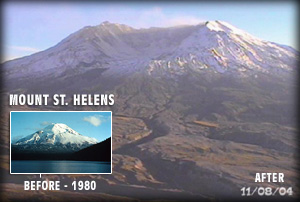
earthquake of 6.0 on the Richter scale. Mt. St. Helens was spewing
huge clouds of steam. A record ten typhoons hit Japan, killing more
than 100 people and causing estimated $6.7 billion damage. Typhoon
Tokage, the deadliest to hit Japan in over two decades, produced a
wave eight stories high and was followed three days later by the
deadliest earthquake in one decade, which destroyed more than 6,000
buildings and caused more than 1,000 landslides.
And, to top it off, On December 26, a 9.0 earthquake shook Sumatra,
causing a tsunami that devastated the shore lines of 12 countries in
the Indian Ocean and is predicted to have killed over 140,000 people
from 37 different nations.
Are there more such cataclysmic events waiting to happen?
Unfortunately, yes. Consider, for instance, a warning that was issued
by a group of researchers at University College London in 1999.
There is a strong possibility, the scientists warned, that the Cumbre
Vieja volcano on La Palma, one of the Canary islands off the North
African coast, could erupt with such force that it would virtually
split the island in two. That would cause a tsunami in the Atlantic
Ocean of such force that tidal waves up to 160 feet high would strike
the North American East Coast, destroying large parts of Boston, New
York, and Miami. "Following an eruption in 1949, scientists found
a fracture running through the western side of the volcano,"
states an article in the Republican. "The land
mass - a half trillion tons of rock - appeared to have slipped 13 feet
toward the sea during the eruption, but friction apparently stopped
the slide."
A new eruption, warns the team from University College London, could
cause the entire land mass to slide into the sea, creating the feared
mega-tsunami. J. Michael Rhodes, a volcanologist at University of
Massachusetts at Amherst, is skeptical. He says there is no way to
predict if and when such a landslide will occur-and what effect it
would have. "[It] really depends on how big the landslide is and
how rapidly it moves. It also depends on whether the land slides all
at once or whether it goes in pieces. And there is no way of knowing
that," he told the Republican.
Then there is America's pending super-volcano in Yellowstone National
Park. In 2004, it showed an alarming rise in sulfuric gases and water
temperature, killing fish and wildlife and causing park rangers to
close some sites to tourism. When (note, we didn't say "if")
a mega-eruption happens, say scientists such as Bill McGuire,
professor of geohazards at the Benfield Greig Hazard Research Centre
at University College London, "the explosion would be the loudest
noise heard by man for 75,000 years." Falling ash, lava flows and
the sheer blow of the eruption would eradicate all life within a
radius of a thousand kilometers, according to McGuire.
Or in the New Madrid zone, for example. This earthquake-prone fault
runs through parts of Illinois, Kentucky, Missouri, Tennessee and
Arkansas. The three earthquakes-each an estimated 8.0 or higher on the
Richter scale-that occurred in 1811 and 1812 near New Madrid, MO are
among the Great Earthquakes of known history and affected the
topography more than any other earthquake in North America. Large
pieces of land sank into the earth, new lakes were formed, the course
of the Mississippi river was changed... so strong were the quakes that
they reportedly rung church bells in New England. Casualties were few,
however, since at that time, the Mississippi river valley was sparsely
settled. A similar earthquake today would cost hundreds of thousands,
maybe millions of lives.
Then there is the fault associated with the meeting of the African and
European tectonic plates that run through the British island of
Gibraltar. Some earth scientists forecast that this is the one most
likely to go, triggering a massive tsunami that would devastate the
coast of Portugal-as it did in 1755 when an estimated 100,000 people
were killed by the disaster.
A recent NY Times editorial titled "
The Year the Earth Fought Back" compares 2004 to 1906, a year
of major earthquakes-including the "Great San Francisco
Earthquakes"-volcano eruptions and other natural disasters around
the world. "Given these cascades of disasters past and
present," wonders author Simon Winchester, "...might there
be some kind of butterfly effect, latent and deadly, lying out in the
seismic world?" He speculates that "the movement among the
world's tectonic plates may be one part of [an] enormous dynamic
system, with effects of one plate's shifting more likely than not to
spread far, far away, quite possibly clear across the surface of the
globe."
What to do? First and probably most important, don't take Mother
Nature for granted. No amount of modernity can tame the earth.
If you live in an area that has been devastated in the past, or that
is at risk, take what steps you can to be prepared-including keeping a
stash of long-lived food and try to secure a source of clean water
(or, the water purification materials needed to create same). Then go
about your business.
EMERGENCY
PREPAREDNESS
Best Bites & Buys publishes
the opinions/ points of view of leading authorities in multiple
fields. The use of these opinions/points of view is in no way a
substitute for legal, accounting, investment, medical or any
professional services to suit your specific personal needs.
Please, always consult a competent/qualified professional for answers
to your specific needs/ questions.
|